You’ve sharpened your knives, you’ve chosen a straightforward recipe, and you’ve even done your mise en place. So why does cooking take too long in your kitchen every single night? The frustrating answer is likely not your skill or the recipe’s complexity—it’s the silent, invisible mistakes in your cooking sequence. Most of us treat meal preparation as a linear checklist: chop everything, then start cooking item A, then move to item B. This creates massive pockets of dead time where you’re waiting instead of doing. The real fix isn’t about moving faster; it’s about thinking smarter by overlapping tasks based on appliance runtimes. By diagnosing the common workflow bottlenecks that steal your time, you can implement simple sequencing fixes that turn a chaotic, drawn-out ordeal into a streamlined, efficient process.
Cooking sessions run long primarily because of inefficient sequencing—treating tasks as a straight line instead of overlapping ‘oven time,’ ‘stovetop time,’ and ‘prep time.’ The easiest fix is to start your longest-cooking appliance first (like preheating the oven) and prep ingredients for the next dish while the current one cooks. This parallel approach eliminates dead time and is the core of cooking workflow efficiency. You save significant minutes not by rushing, but by reordering your steps strategically.
The Real Culprit: It’s Your Sequence, Not Your Speed
You’ve sharpened your knives and chosen simple recipes, yet dinner is still late. The root cause of why cooking takes too long in the kitchen isn’t your chopping pace—it’s an invisible time sink in your cooking workflow efficiency. Most home cooks treat meal preparation as a straight line: read the recipe, prep every ingredient, then start cooking each component one after another. This linear approach creates massive pockets of dead time where you’re waiting instead of doing.
The secret to faster meals is parallel processing. Think of your kitchen as having three main resources: oven time, stovetop time, and your hands-on prep time. The goal is to overlap them, not use them sequentially. When you wait for the oven to preheat with empty hands, or chop vegetables while your pan sits cold, you’re adding unnecessary minutes. Fixing these kitchen workflow bottlenecks is less about moving faster and more about ordering smarter.
The 3 Most Common Sequencing Mistakes (And How to Spot Yours)
These specific, repeated errors are the main culprits behind long cook times. See if any sound familiar.
1. The ‘Cold Start’ Mistake
Symptom: You begin every recipe by prepping ingredients, then turn on the oven or burner as step two.
The Flaw: This is a classic appliance sequencing mistake. Ovens and pans take the longest to reach temperature. By not preheating them the absolute moment you know you’ll need them, you’re adding 10-20 minutes of pure waiting time to your session. Your active prep should happen while the appliance heats up.
2. The ‘Single-File Line’ Mistake
Symptom: You complete all chopping, measuring, and marinating before any cooking begins.
The Flaw: This treats cooking like a checklist, not a symphony. It ignores the natural pauses within recipes. For example, while chicken roasts for 25 minutes, you have a perfect window to wash and trim green beans. Doing all prep upfront means you stand idle during cook times instead of preparing the next component.
3. The ‘Appliance Shuffle’ Mistake
Symptom: You constantly switch between oven, stove, and counter tasks in a reactive, hectic way.
The Flaw: This lacks a plan for parallel cooking tasks. You might sear meat on the stove, then realize the oven isn’t hot for finishing it, so you scramble. Or you use the stove for one dish, turn it off, then need it again later, wasting time reheating. Efficient sequencing groups appliance use to minimize stops and starts.
The Fix: Re-sequence Any Meal in 4 Steps
You can apply this universal method to any recipe tonight. It shifts your focus from “what’s next in the recipe” to “what resource is free right now.”
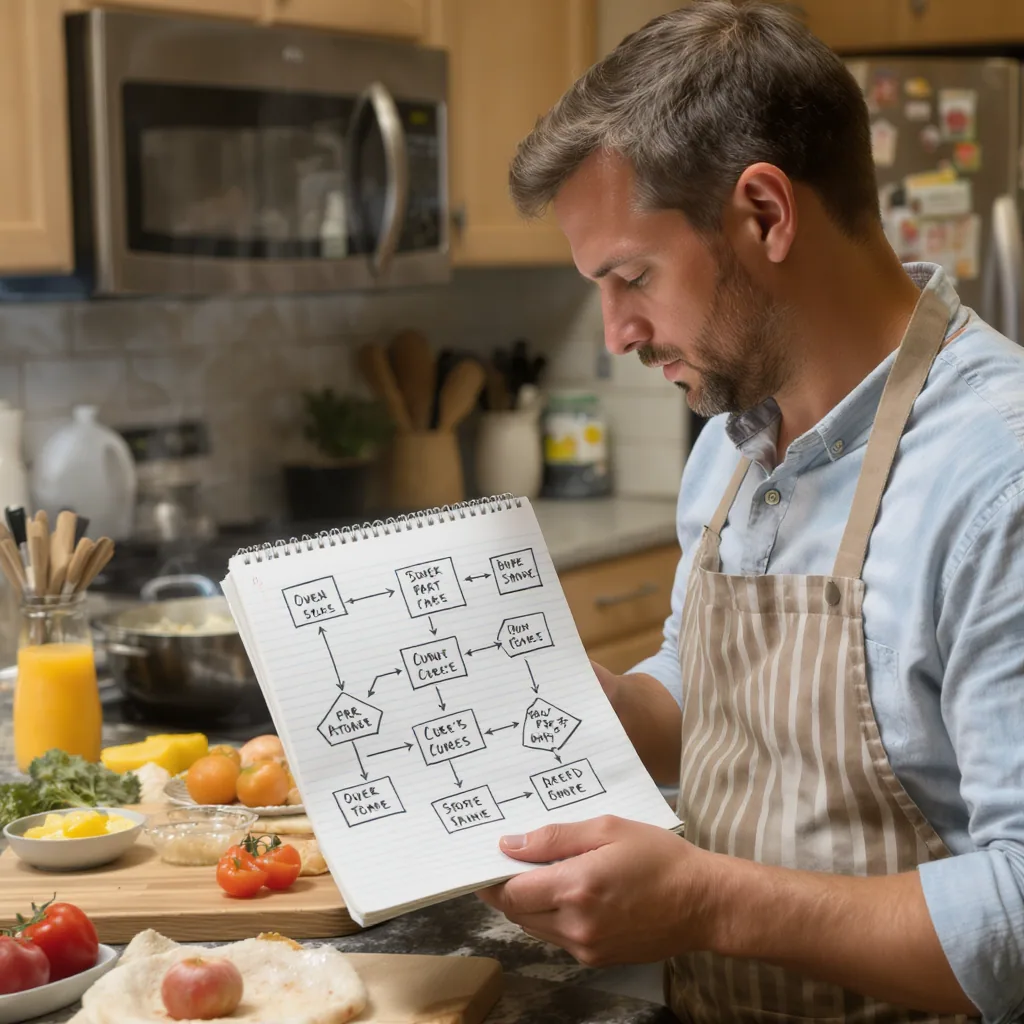
Step 1: Identify the “Anchor”
Before you touch a pan, scan your recipe(s) and ask: “What item or appliance has the longest, uninterrupted cook time?” This is your anchor. It’s often something roasting in the oven (like chicken or potatoes) or a simmering pot on the stove. Your entire sequence will be built around starting this anchor first.
Step 2: Start the Anchor FIRST
Immediately preheat the oven or get the necessary pot/pan on the burner. This is the most critical step to fix appliance timing mistakes. While it heats, begin prepping the anchor ingredient itself (e.g., seasoning the chicken).
Step 3: Prep for the Next Step While the Current One Cooks
Once the anchor is cooking, use that free time (often 10-30 minutes) productively. This is where you achieve true cooking workflow efficiency. Wash and chop side dish veggies, make a salad dressing, or set the table. You’re filling “oven time” with “hands-on time.”
Step 4: Clean As You Go, Within the Sequence
Don’t save all cleaning for the end. Use tiny waiting moments (e.g., while oil heats, during a two-minute simmer). Toss scraps, rinse a bowl, or load the dishwasher. This prevents a mountain of dishes from becoming a final, time-consuming hurdle.
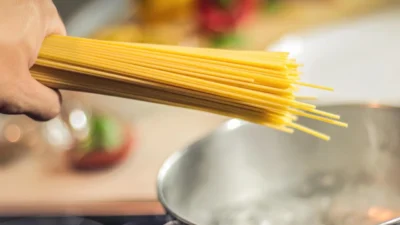
Quick Scenario: For a pasta dinner, your anchor is the boiling water. Put the pot on, add water, and turn the burner to high. While it comes to a boil (long wait), you can chop garlic and tomatoes for the sauce. The water boils, you add pasta (cooks for 10 mins). While pasta cooks, you sauté the sauce. Tasks overlap perfectly.
Putting It Into Practice: A Weeknight Dinner Scenario
Let’s make the theory concrete with a common meal: roasted chicken thighs, potatoes, and steamed green beans.
Inefficient Linear Sequence (45+ minutes, stressful):
1. Prep chicken (5 mins). 2. Preheat oven (15 mins wait). 3. Roast chicken (25 mins) – you wait. 4. Prep potatoes (10 mins). 5. Roast potatoes (30 mins) – you wait. 6. Prep green beans (5 mins). 7. Steam beans (8 mins). Total: Long, with over 40 minutes of combined waiting.
Optimized Parallel Sequence (30-35 minutes, relaxed):
1. Preheat oven to 425°F (START ANCHOR). While it heats, prep chicken and potatoes. 2. Put chicken and potatoes in the oven together (they can roast at the same temp). 3. While they roast for 25 mins, wash and trim green beans, set the table, make a quick sauce. 4. In the last 10 minutes of roasting, steam the beans on the stovetop. Everything finishes around the same time.
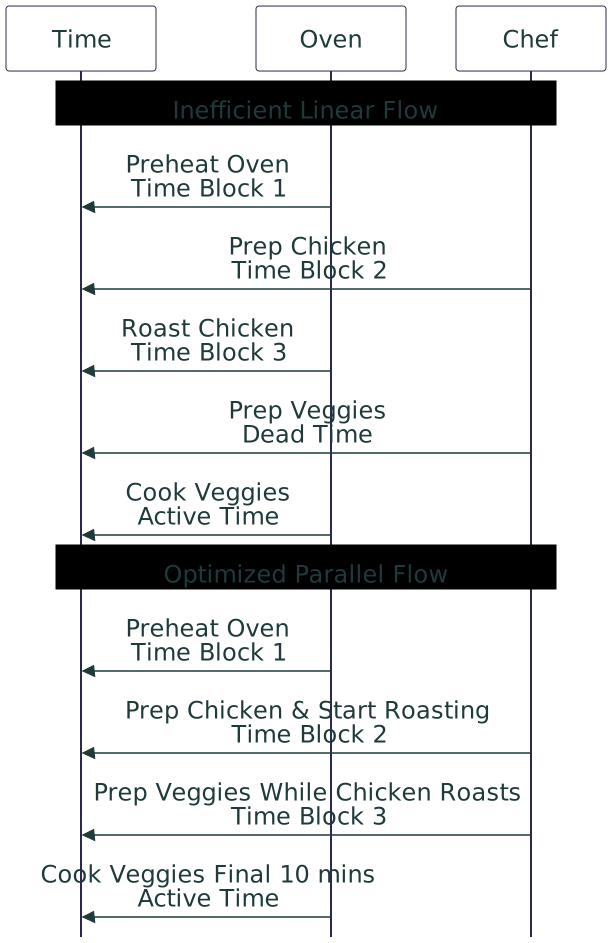
See the difference? The optimized flow overlaps oven preheat with prep, and uses the oven time to complete stovetop and final prep tasks. This is the power of correct meal prep sequencing.
Start Your Longest Cook First, Tonight
Getting dinner on the table faster isn’t about becoming a lightning-fast chef. It’s about eliminating the hidden waits created by a linear cooking order. By focusing on your appliance sequence and overlapping tasks, you reclaim those lost minutes and reduce stress.
The next step is immediate and simple: choose one meal you’re making soon. Before you start, identify the “anchor”—the longest-cooking element—and commit to turning on that oven or burner the very first moment you can. Build the rest of your work around its cook time. You’ll likely shave 15-20 minutes off your usual routine with no extra effort, just smarter ordering.