You might think the biggest sin of an overcrowded air fryer basket is soggy fries or floppy chicken wings. And you’d be right—but that’s only half the story. The hidden, more frustrating cost of cramming in that extra handful of food is wasted time and energy. Your air fryer isn’t just a small oven; it’s a precision convection device that relies on unimpeded, rapid air movement to cook. When you block that airflow by overstuffing the basket, you’re not just risking uneven results—you’re forcing the appliance to work harder and longer to achieve the same effect, turning a quick-cook promise into a drawn-out wait. Understanding this principle is the key to unlocking your air fryer’s true efficiency and getting back to the fast, crispy meals you bought it for.
Air fryer basket crowding increases cooking time because it blocks the rapid hot air circulation the appliance relies on. The heating element must run longer to compensate for the blocked airflow and cold spots created by packed-in food. The safest fix is to cook in smaller, spaced-out batches, which ensures even cooking, prevents safety hazards like undercooked food, and is ultimately more efficient than one long, ineffective cycle.
The Science of Crowding: Why More Food = More Time
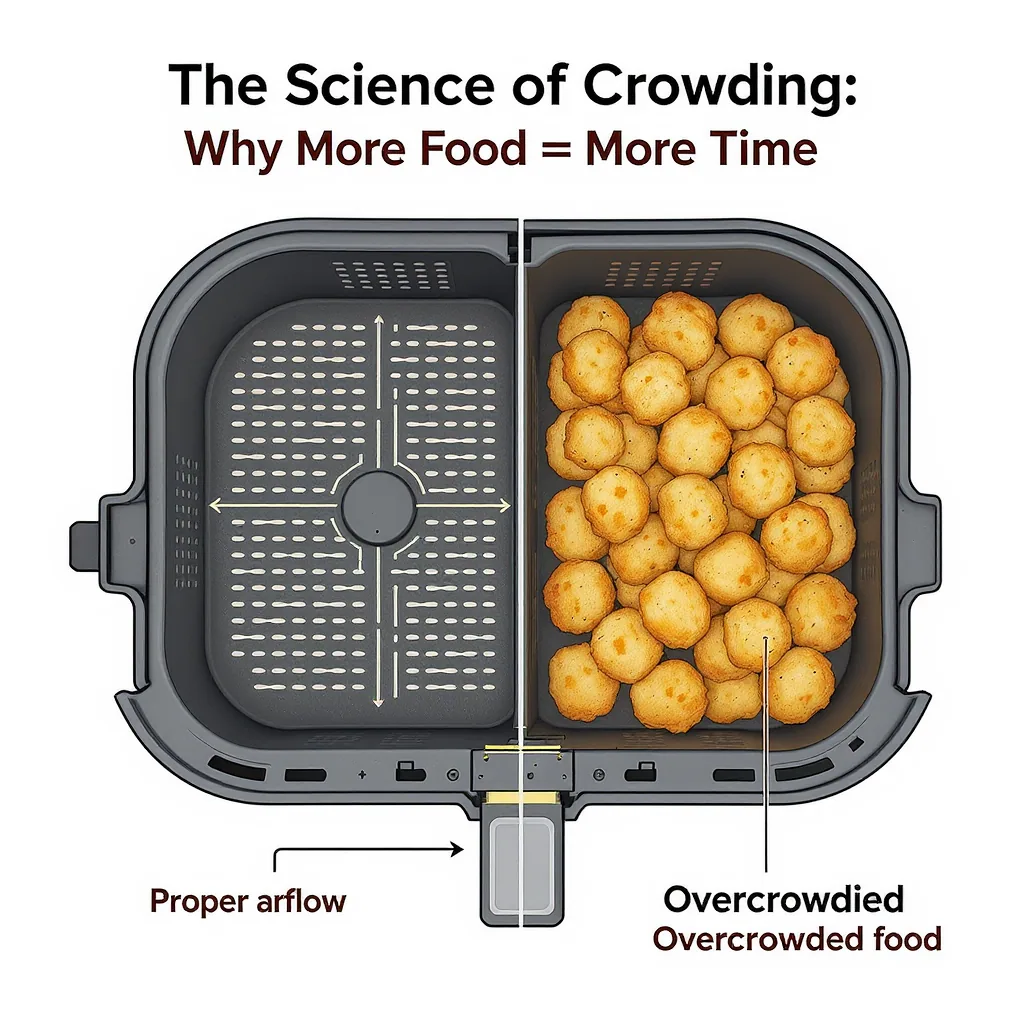
An air fryer is essentially a powerful, compact convection oven. It works by rapidly circulating super-heated air around your food. This process, known as convection, creates a crisp exterior while cooking the interior quickly and evenly. The key to this entire system is unobstructed airflow.
When you overcrowd the basket, you create a physical barrier. The hot air can’t flow freely between the pieces of food. Instead, it gets trapped above the dense layer or deflects around the edges. This creates “cold spots” where the air can’t reach, and the heating element has to work harder and longer to try to bring the entire chamber up to the set temperature. The result is a direct increase in your air fryer cooking time, as the appliance struggles to do its job against the blockage you’ve created.
Beyond Sogginess: The Real Costs of an Overstuffed Basket
Sure, a soggy fry is disappointing, but the consequences of an overcrowded air fryer basket go much deeper. Let’s walk through a common scenario: you’re in a rush and pile in frozen chicken tenders and fries, filling every square inch. Here’s what actually happens.
First, you get wildly uneven results. The pieces on the outer edges may burn while the ones in the middle stay pale and undercooked—a genuine food safety concern. To compensate, you add more time, turning a 12-minute cook into an 18-minute one. This is a classic air fryer efficiency mistake. That extra runtime translates directly into air fryer cook time energy waste, driving up your electricity bill. Over time, forcing the heating element and fan to run longer than designed can also contribute to extra wear on your appliance, potentially shortening its lifespan.
Your Safe Fix Protocol: From Crowded to Perfect
Photo by Ron Lach on Pexels
Fixing crowding isn’t about guesswork; it’s a simple, repeatable protocol. Follow these steps for safe, efficient cooking every time.
Step 1: Assess & Remove Excess
Before you even turn the machine on, look at your loaded basket. If food is piled high or pieces are touching on all sides, you already know it’s too much. Remove about a third of the food and set it aside. It’s better to cook a perfect small batch than a failed large one.
Step 2: Enforce the Single Layer Rule
With rare exceptions for very small items like peas, air fryer food placement must be in a single, even layer. No stacking. This is non-negotiable for proper air fryer airflow.
Step 3: Apply the Finger-Width Gap Test
Once in a single layer, nudge pieces so there’s a small gap between them—about the width of your finger. This space is the highway for hot air. Proper air fryer spacing ensures every surface gets hit by that circulating heat.
Step 4: Embrace the Batch Cooking Strategy
For larger quantities, air fryer batch cooking is the answer. Cook your first, perfectly spaced batch. While it’s cooking, prep the next batch on a tray. The air fryer cools quickly, so you can load and start the second batch almost immediately. The total active time is barely more, but the results are consistently excellent.
Step 5: Shake or Flip Midway (For Full Baskets)
Even in a correctly spaced, single-layer batch, give the basket a firm shake or flip items with tongs halfway through cooking. This ensures all sides get equal exposure to the heat source, guaranteeing even browning and cooking.
Common Crowding Mistakes (And How to Avoid Them)
Many air fryer efficiency mistakes stem from good intentions. Recognizing these common pitfalls is half the battle.
Mistake: Dumping in frozen food straight from the bag. Clumped-together fries or nuggets steam each other and block airflow.
Fix: Break apart frozen clumps on a plate before adding them to the basket to ensure separate pieces.
Mistake: Ignoring food expansion. Bacon shrinks, but many foods (like pastries or some vegetables) expand as they cook, closing any gaps you started with.
Fix: Give expanding foods even more initial space than you think they need.
Mistake: Trying to cook an entire multi-component meal at once. Different foods have different cook times and temp requirements.
Fix: Cook items sequentially, starting with the one that requires the lowest temperature, or use accessory racks wisely (ensuring even spacing on each level).
Mistake: Using the wrong basket liner. Solid parchment liners or foil can completely block the bottom vents, crippling airflow from below.
Fix: Use perforated parchment liners designed for air fryers, or better yet, go liner-free for the best possible air fryer performance.
Better Results Start with a Little Space
Overcrowding your air fryer is a universal learning step—almost everyone does it at first. The good news is that it’s one of the easiest habits to correct. By shifting your mindset from “one-and-done” to “smart batches,” you actually save time in the long run by eliminating guesswork, re-cooks, and wasted energy.
Adopting the simple protocol of assessing, spacing, and batching will transform your cooking results from inconsistent to reliably crispy and perfectly cooked. It’s the safest way to protect your investment, ensuring your appliance runs efficiently and safely for years to come. Your air fryer—and your dinner—will thank you.