What if the secret to a perfectly roasted chicken and lower energy bills wasn’t a new, high-tech appliance, but a simple shift in mindset? The most effective oven baking and roasting efficiency guide often starts with a counterintuitive truth: achieving better results with less energy frequently means doing *less*, not more. We’ve been conditioned to believe maximum preheating and cranking the dial guarantee culinary success, but this overlooks the fundamental thermal physics at play in your kitchen. True efficiency is a blend of understanding how your oven retains and transfers heat, and adopting smart, almost effortless habits that work with these principles. This isn’t about sacrifice; it’s about working smarter to reduce waste, save money, and ironically, often produce more consistent and superior food by mastering the environment you already have.
Maximizing your oven’s efficiency is less about the appliance itself and more about mastering heat retention and transfer. The core principles are minimizing thermal loss, using the oven’s full capacity wisely, and letting residual heat finish the job. You achieve this by understanding your oven’s heat behavior, preheating selectively only when texture is critical, keeping the door firmly shut, choosing the right cookware, and strategically loading multiple items to amortize the energy cost of each cycle.
The Thermal Physics of Your Oven (It’s Not Just a Hot Box)
To truly master energy efficient oven baking, you need to understand the basic physics at play. Your oven isn’t just a box that gets hot; it’s a system constantly battling to maintain a set temperature against inevitable heat loss. The three main methods of heat transfer are all at work here:
- Conduction: Heat travels directly from the hot oven rack into your baking sheet.
- Convection: Hot air circulates, either naturally (in conventional ovens) or forced by a fan, transferring energy to the food’s surface.
- Radiation: Infrared energy beams directly from the heating elements and hot oven walls to the food.
The goal is to reach and maintain thermal equilibrium—a stable state where the oven cavity is evenly heated. Every time you open the door, cold air rushes in, and heat escapes, forcing the elements to fire up again to recover. This cycle is the primary enemy of thermal efficiency.
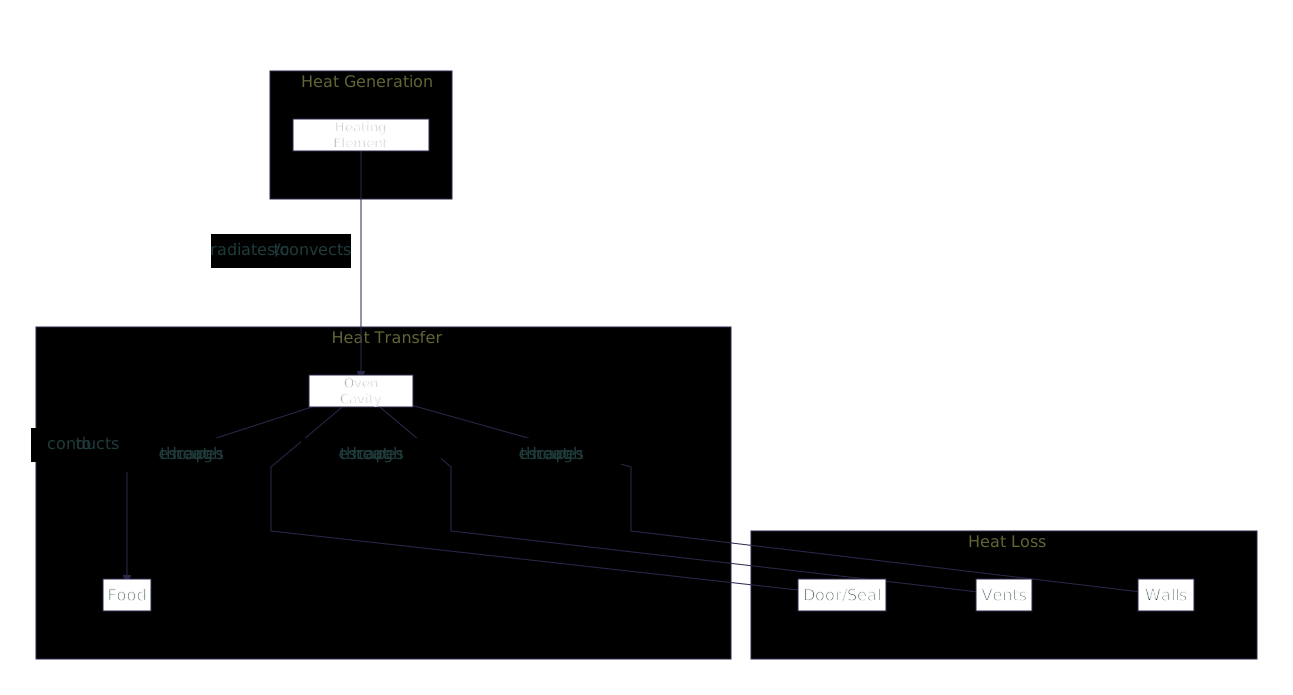
Key points of heat loss are the door seal, the vents (necessary for moisture and gas release), and the oven walls themselves. A well-insulated, modern oven is designed to minimize this loss, but the principles of managing it are universal. Understanding this battle between heat generation and heat loss is the first step in any serious oven baking and roasting efficiency guide.
The Preheating Paradox: When to Skip It Entirely
The cardinal rule of baking has always been “preheat your oven.” But for true energy efficient oven baking, this rule is more of a guideline. Preheating is crucial for recipes where an immediate blast of high heat is needed to trigger a chemical reaction, like the rapid rise of yeast breads or the “oven spring” in pastries. For these, skipping preheat means flat, dense results.
However, for many other dishes, preheating is an energy waste. Think about hearty casseroles, whole roasted vegetables, or large cuts of meat that cook for an hour or more. These items start in a cold oven and gradually come up to temperature with the cavity. The extended, gentle heat can often lead to more tender results and saves the energy required to bring an empty oven up to 400°F before you even start.
Practical Guideline: If your recipe relies on precise timing and chemical reactions in the first 10 minutes (soufflés, cookies, pizza), preheat. If it’s a long, slow cook where the journey is more important than the start (pot roast, baked pasta, whole squash), you can often place it in a cold oven and adjust the timer. This single habit is a powerful energy-saving baking technique.
Strategic Oven Loading: The Batch Cooking Efficiency Hack
One of the most effective oven roasting energy tips is to maximize every heating cycle. If you’re using 20% of your oven’s volume to bake one potato, you’re paying to heat 100% of the cavity. The solution is strategic batch cooking.
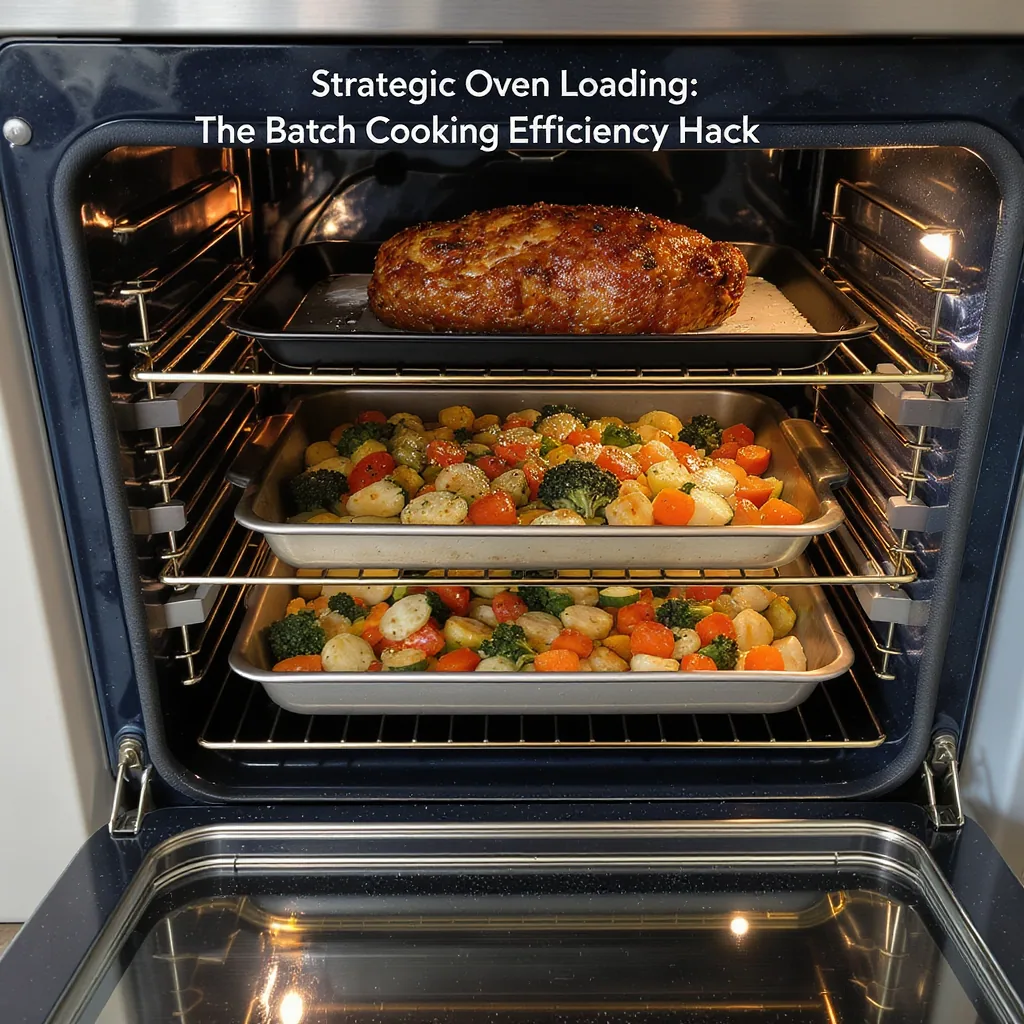
Do: Plan meals that cook at similar temperatures. A roasted chicken at 375°F can share the oven with root vegetables and a bread pudding. Stagger pans front-to-back and side-to-side to ensure heat distribution. Use multiple racks and rotate pans halfway through cooking to combat hot spots.
Don’t: Overcrowd the oven. Blocking the airflow (especially in convection ovens) prevents even cooking and forces longer bake times, negating any savings. Avoid placing a dripping pan directly above another dish without a catch tray. And don’t mix a very wet dish (like a casserole) directly above something that needs a dry, crisp finish (like roasted potatoes), as the steam will interfere.
Your Batch Cooking Checklist
- Group dishes with similar target oven temperatures (±25°F).
- Position items needing the most heat (browning, crisping) on higher racks.
- Leave at least 1-2 inches between pans and the oven walls for air circulation.
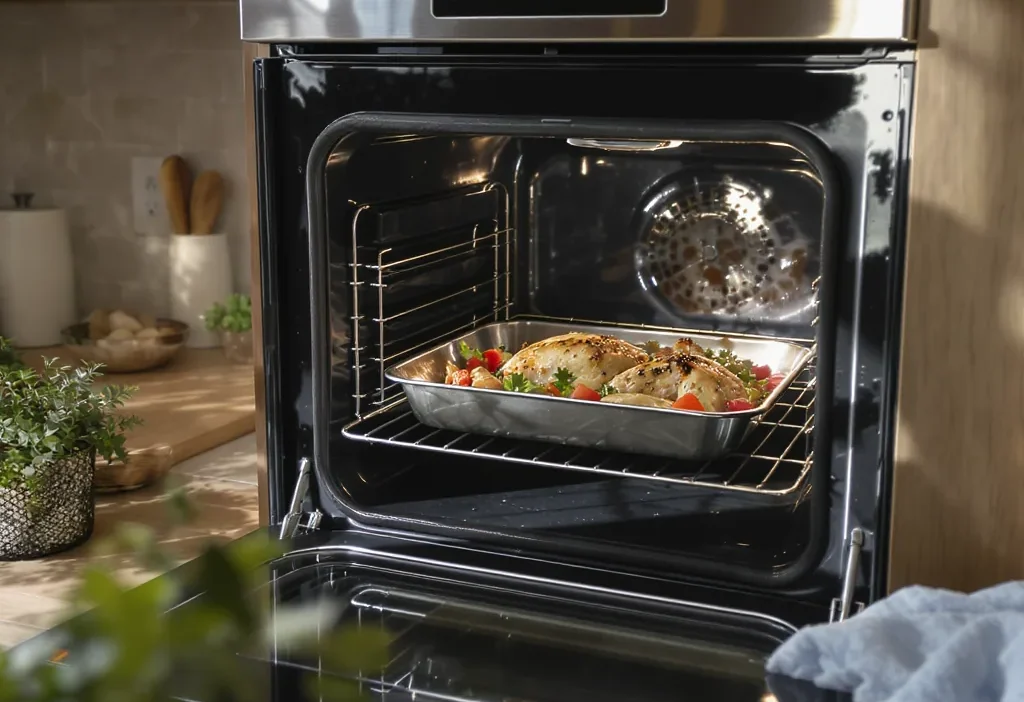
- Use the oven light and window to check progress before resorting to opening the door.
The Silent Energy Drains: Door Peeking and Cookware Choices
Two of the biggest, yet most overlooked, factors in oven efficiency are your own habits and your tool choices.
The Cost of Curiosity (Door Peeking)
It’s tempting to check on your food, but every door opening causes a massive thermal dump. Estimates suggest the internal temperature can drop 25°F to 50°F or more in seconds. The oven then must work hard, drawing significant power to recover. Using the interior light and window is a zero-cost alternative. If you must open the door, do it quickly and at a planned moment, like when it’s time to rotate a pan.
Your Pan is a Heat Conductor
The material, color, and even cleanliness of your bakeware dramatically affect cooking. Dark, matte, or anodized pans absorb radiant heat more efficiently than shiny, light-colored ones. This means they transfer heat to food faster, often leading to over-browning if you don’t adjust. Glass and ceramic dishes heat slowly but retain heat exceptionally well, ideal for casseroles and custards.
For efficient oven use, match the pan to the task: use rimmed, dark metal sheet pans for roasting vegetables to promote browning, and light-colored aluminum pans for delicate cookies to prevent burnt bottoms. Also, ensure your pans are the right size for the job; an oversized pan for a small item wastes energy heating excess metal.
Leveraging Residual Heat and Smart Shut-Off
The most advanced technique in this oven baking and roasting efficiency guide is learning to let the oven’s retained energy work for you. Just as a large roast continues to cook internally after being removed from the heat (carryover cooking), your oven’s stored thermal energy can finish the job without the elements being on.
For many dishes, you can safely turn the oven off 5 to 10 minutes before the scheduled end of cooking. The residual heat trapped in the oven walls, racks, and even the food itself will provide enough energy to complete the process. This works perfectly for casseroles, roasted vegetables, baked pasta, and even some cookies. It’s the ultimate application of the “do less” principle for energy-saving baking techniques.
Important Safety Note: Always verify food is done by checking its internal temperature with a reliable thermometer, especially for meats and poultry. This method is about optimizing oven performance, not compromising food safety. Start by experimenting with dishes you know well, and note how much time you can shave off the active cooking cycle.
Efficiency is a Skill You Already Own
Mastering your oven’s efficiency isn’t about buying a new, expensive appliance or memorizing complex rules. It’s about shifting your perspective to see heat as a resource to be managed, not just a setting to be dialed. The small, mindful changes—checking the window instead of the door, loading the oven with purpose, or daring to skip a preheat—compound into real savings on your energy bills and often lead to better, more consistent cooking results.
You are now equipped with the principles of thermal physics and a toolkit of practical habits. Start with one change that feels manageable. Perhaps it’s committing to one batch-cooking session a week or experimenting with residual heat on your next tray of roasted vegetables. Over time, these actions become second nature, transforming you from a passive user into an efficient operator of one of your kitchen’s most powerful tools.
This guide to oven efficiency revolves around core principles of heat management. Understand that your oven constantly loses heat, so your goal is to minimize that loss. Preheat selectively—only for recipes that need an immediate high-heat reaction. Maximize each heating cycle by batch-cooking compatible dishes at the same time. Resist the urge to open the door, and choose your cookware wisely, as dark metal pans conduct heat faster than glass or light-colored ones. Finally, harness the oven’s residual heat by turning it off a few minutes early for suitable dishes. Implement these strategies one at a time to reduce energy use and improve your cooking.