When you’re trying to cut down on your kitchen’s energy use, the common wisdom is simple: the slow cooker is the undisputed champion of efficiency. It just sits there all day, humming along on a low wattage, so it must be the winner, right? The reality of pressure cooker vs slow cooker energy use is far more interesting and counterintuitive. The most energy-efficient choice isn’t about the appliance itself, but about the dance between its power, your cooking time, and what’s in the pot. This practical guide cuts through the assumptions to show you when the fast fury of a pressure cooker saves more electricity and when the gentle, all-day warmth of a slow cooker is the smarter play for your wallet and your schedule.
How do you choose between a pressure cooker and a slow cooker to save the most energy? The answer isn’t one-size-fits-all. For quick meals from tough ingredients, a pressure cooker wins by cooking in a fraction of the time. For unattended, all-day cooking of soups and stews, a slow cooker’s low wattage makes it more efficient. Your final decision should be based on cooking time, ingredient type, and your daily schedule.
The Core Energy Equation: Time vs. Wattage
To truly understand the pressure cooker vs slow cooker energy use debate, you need to know how your electricity bill is calculated. The unit you pay for is the kilowatt-hour (kWh). It’s simply your appliance’s power (measured in watts) multiplied by the time it runs (in hours).
Think of it like filling a bathtub: a high-pressure faucet (high watts) can fill it in 5 minutes, while a slow trickle (low watts) might take an hour. The total water used is the same, but the rate and time are different. This is the fundamental trade-off between these appliances.
A modern electric pressure cooker is a high-watt appliance, often drawing between 1000 and 1500 watts. But it cooks food in a fraction of the time—often 20 to 60 minutes. A slow cooker, by contrast, uses a very low wattage, typically between 75 and 250 watts, but it runs for 4 to 10 hours. The winner in total energy consumed depends entirely on which combination results in fewer watt-hours.
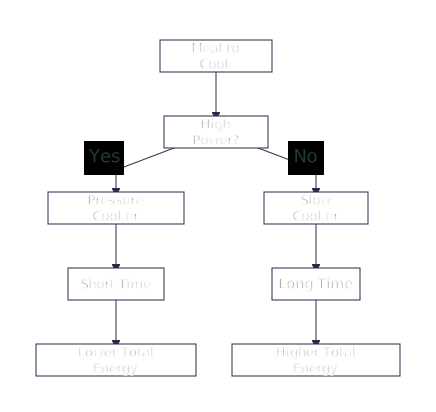
| Feature | Electric Pressure Cooker | Slow Cooker |
|---|---|---|
| Typical Wattage | 1000–1500W | 75–250W |
| Best For | Tough cuts of meat, dry beans, quick broths | Soups, stews, tender meats, all-day simmering |
| Ideal Cook Time | 20–60 mins (plus pressurize/depressurize) | 4–10 hours on LOW |
| Energy Use Estimate | ~0.3–0.8 kWh per cook | ~0.3–1.0 kWh per cook |
| Choose When… | You need speed from tough ingredients and are home to manage it. | You can start early and want unattended, gentle cooking all day. |
Estimates are illustrative. Actual use varies by model, recipe, and settings. For more on how home energy use is measured, the U.S. Department of Energy provides a useful guide.
Pressure Cooker: The Fast & Frugal Powerhouse
Where the pressure cooker becomes an energy-saving superstar is with ingredients that traditionally demand long, energy-intensive cooking. Its superpower is using high pressure to dramatically raise the boiling point of water, cooking food much faster.
Scenarios Where It Saves the Most Energy
Use your pressure cooker when you want to transform hard, fibrous, or dry ingredients into a tender meal in under an hour. The pressure cooking energy savings are most dramatic compared to using a standard oven or stovetop for the same task.
- Tough Cuts of Meat: Turning a chuck roast into fall-apart tender takes 45-60 minutes instead of 3-4 hours in an oven.
- Beans from Dry: No more overnight soaking. Cook dry beans in 30-45 minutes without pre-soaking, saving hours of simmering.
- Bone Broths & Stocks: Extract deep flavor and gelatin in 1-2 hours instead of a half-day simmer on the stove.
Because it’s sealed, very little heat and moisture escape, making the cooking process incredibly efficient. The total electric pressure cooker power consumption for one of these meals is often less than running your oven for just 30 minutes.
Slow Cooker: The Low & Steady Champion
The slow cooker’s efficiency comes from its remarkably low power draw—often comparable to a standard light bulb. Its “set it and forget it” nature is perfect for scenarios where time is not a constraint, but attention and electricity use are.
Scenarios Where It’s the Efficient Choice
Choose your slow cooker when you have the luxury of time and want a truly hands-off approach. Its slow cooker electricity usage is minimal per hour, making it ideal for long, unattended cooks.
- All-Day Simmering: Perfect for soups, stews, and chili where flavors benefit from melding together over many hours. You can start it in the morning and come home to dinner.
- Already-Tender Ingredients: Cooking chicken breasts, pork tenderloin, or root vegetables on LOW keeps them moist without the risk of overcooking common in a pressure cooker.
- The “Keep Warm” Function: Modern slow cookers hold food at a safe temperature with very little additional energy, making it cheaper than reheating later.
For these tasks, the math of efficient slow cooking vs pressure cooking tips in the slow cooker’s favor. Using a high-watt pressure cooker for 8 hours would be wildly inefficient, but the slow cooker’s low wattage makes the long cook time cost-effective.
Your Decision Guide: Which Appliance When?
Forget memorizing specs. The best choice boils down to your answers to three simple questions. Use this guide to make the call for any meal.
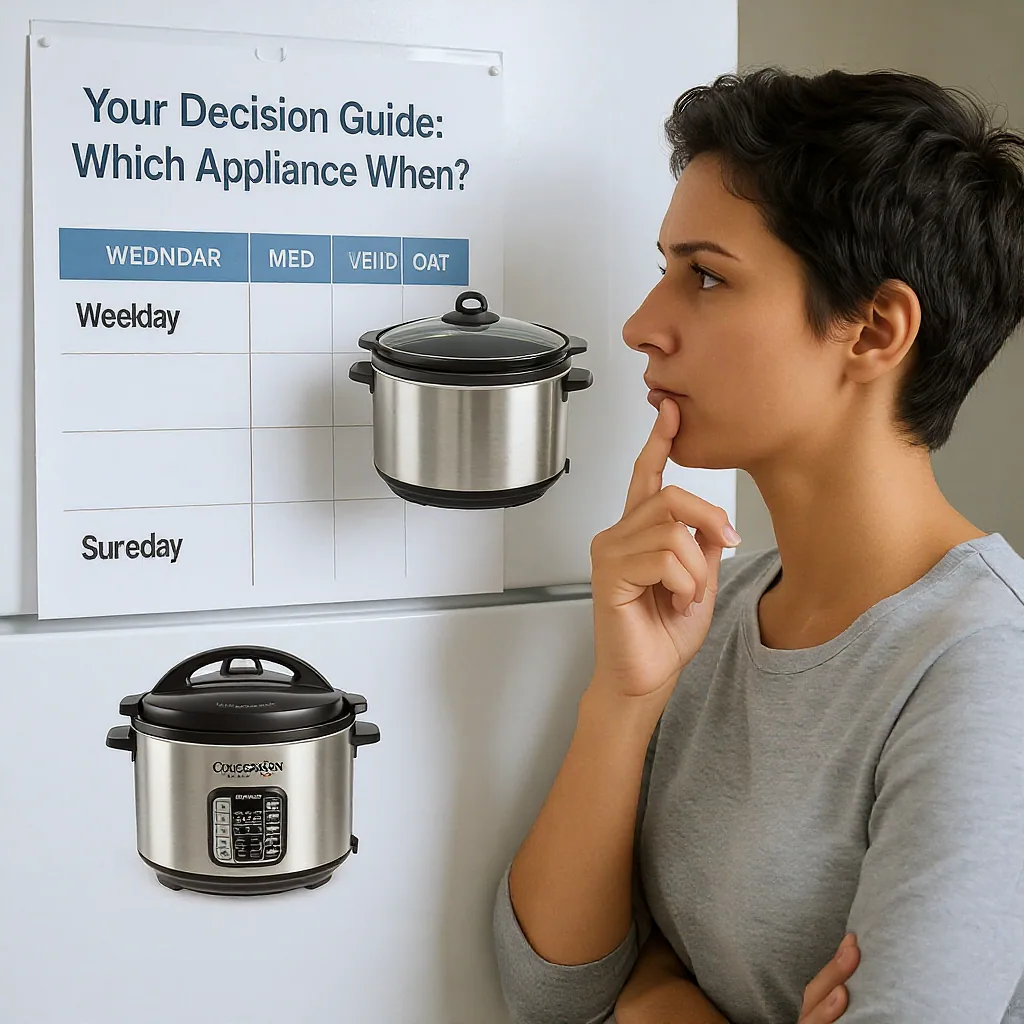
1. What are the main ingredients?
Choose the Pressure Cooker if: You’re starting with hard, dry, or tough elements that need breaking down—like a pot roast, dry beans, or a whole chicken for shredding.
Choose the Slow Cooker if: Your ingredients are already fairly tender (chicken breasts, pre-soaked beans, diced potatoes) or you’re making a soup where long simmering improves flavor.
2. What’s your timeline?
Choose the Pressure Cooker if: You need dinner in 1 hour or less. It’s the champion of quick, from-scratch meals on busy weeknights.
Choose the Slow Cooker if: You have 4+ hours and prefer to start cooking in the morning or afternoon for an evening meal. Time is your ally.
3. Will you be home to manage it?
Choose the Slow Cooker if: You’ll be out of the house for 6+ hours. Its safety and low power make it ideal for unattended cooking.
Choose the Pressure Cooker if: You’ll be home during the cook cycle. While largely hands-off, it requires you to be present to start it and handle the quick release (if needed).
This multicooker energy comparison isn’t about one being universally better. It’s about matching the tool’s strengths to your specific meal and schedule to minimize total energy consumption.
Start Saving with Your Next Meal
The most effective way to cut your kitchen energy use isn’t to buy a new gadget—it’s to use the ones you have more strategically. Both your pressure cooker and slow cooker are powerful tools for efficiency, but each has its ideal role.
Your decisive next step is simple: look at your meal plan for this week. Pick one or two dishes you normally make—perhaps a chili or a pot roast—and apply the three-question guide above. Decide which appliance is the true energy-saver for that specific recipe. By making this intentional choice just a couple of times a week, you’ll start seeing the difference on your electricity bill without changing what you eat.
Q: Can I use a pressure cooker as a slow cooker?
A: Many modern electric pressure cookers (like the Instant Pot) have a “Slow Cook” function. However, it often doesn’t get as low or distribute heat as evenly as a dedicated slow cooker. For best results, especially with all-day cooks, a dedicated appliance is usually more reliable and efficient.
Q: Is it cheaper to use a pressure cooker or an oven?
A: Almost always the pressure cooker. A typical oven uses 2000-5000 watts. Even for a one-hour roast, an oven can use 2-5 kWh, while a pressure cooker might complete the same task in 45 minutes using 0.5-0.8 kWh. The pressure cooker’s sealed environment and faster time make it the clear winner for energy savings.
Q: Do older slow cookers use more energy than new ones?
A: Not necessarily. The basic heating technology hasn’t changed dramatically. However, newer models often have better insulation, more precise thermostats, and programmable timers that can automatically switch to a “Keep Warm” setting, which may prevent unnecessary extended cooking and save a small amount of energy.