You set the timer, hit start, and wait for your perfectly reheated meal. Instead, you get a plate of food with Sahara-dry edges and a still-frozen center, while your microwave hums away, burning through electricity for no good reason. Most of us blame the timer, but the real culprit behind microwave overcooking and energy waste is a fundamental misunderstanding of how microwaves work. It’s not about time; it’s about power distribution and moisture control. This dual problem—ruined food and a silently climbing energy bill—is frustratingly common, but the fix is simpler than you think. This isn’t a deep dive into appliance engineering; it’s a quick-play protocol to retrain your microwave habits, stop the waste, and save your dinner.
Microwave overcooking happens because the waves heat unevenly and evaporate moisture too quickly, leading to dry, tough spots and wasted energy. To fix it, immediately switch to using 50-70% power for longer times, stir halfway through, and always cover your food with a vented lid. This simple adjustment ensures even heating, preserves moisture, and uses electricity more efficiently.
The Real Culprits: Why Your Microwave Overcooks
To fix the problem, you first need to understand it. The core issue isn’t just your timer; it’s how microwaves work. They generate waves that excite water molecules in your food, creating heat. The problem is, these waves don’t distribute evenly inside the cavity. They create concentrated areas of energy called “hot spots,” while leaving other areas cold. This is why you get those frustratingly dry, tough edges while the center is still frozen.
The second major factor is moisture loss. When you blast food on high power, the water molecules on the surface heat up and evaporate extremely quickly. This rapid moisture loss is what turns your pasta rubbery and your chicken jerky-like. Essentially, you’re not just cooking the food; you’re actively drying it out from the outside in. This process is a direct cause of microwave overcooking energy waste—you’re using extra electricity to ruin your meal and create more food waste. For a deeper dive into the science, resources like the FDA’s overview of microwave oven radiation explain the heating mechanics clearly.
Your Quick Energy-Saving Fix Protocol
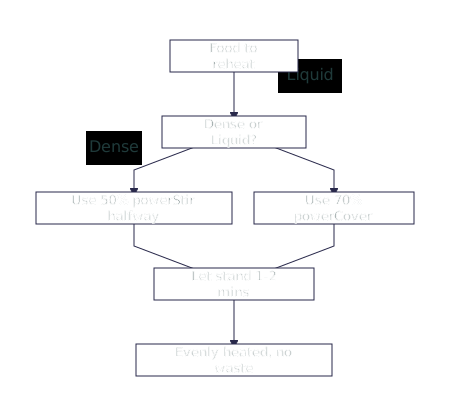
Stop guessing and start using this simple, four-step protocol. It’s designed to combat uneven heating and moisture loss directly, saving your food and your energy bill.
1. Dial Down the Power
This is your most powerful tool. For 90% of reheating and cooking, you don’t need 100% power. Switch to 50-70% power. This gentler heating allows warmth to penetrate to the center without scorching the exterior, preventing those dry, overcooked edges.
2. Add Time, Not Power
Lower power means you need more time. A good rule of thumb: if a recipe says 2 minutes on high, try 3-4 minutes on 50% power. It feels slower, but it actually uses less total energy because you’re not fighting rapid evaporation and you’ll avoid having to re-cook cold spots.
3. Stir & Rearrange
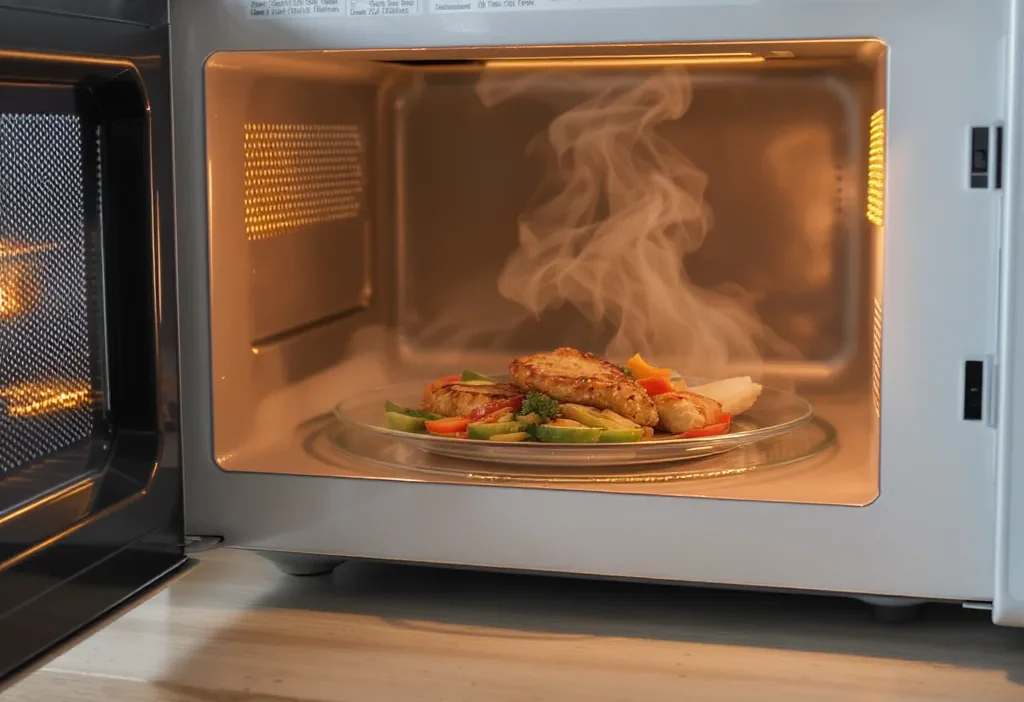
Manually combat those hot spots. For soups and sauces, stir halfway through. For solid items like a plate of leftovers, simply rotate the plate 180 degrees or move items from the edge to the center. This simple act is the best way to achieve even microwave heating.
4. Cover It Up
Always cover your food with a vented microwave-safe lid or a damp paper towel. This traps steam, which keeps the surface moist and helps distribute heat more evenly. It’s a non-negotiable step to avoid reheating too long and ending up with dried-out food.
Common Microwave Mistakes That Waste Energy
Many of our default habits are the root cause of ruined meals and higher electricity use. Here’s a quick list of what to stop doing and what to do instead.
Don’t: Use the “High” power setting for every single task.
Do: Match the power to the job. Use medium (50-70%) for reheating, low (30-50%) for defrosting or softening.
Don’t: Place food dead-center on the rotating plate.
Do: Arrange food in a ring around the outer edge. The turntable helps, but the waves are stronger at the edges, promoting more even cooking.
Don’t: Open the door the second the timer beeps and dig in.
Do: Let food stand for 1-2 minutes after cooking. This “carryover cooking” allows heat to finish distributing evenly, so you’re less tempted to zap it again.
Don’t: Use metal, non-microwave-safe plastics, or containers that are too shallow.
Do: Use microwave-safe glass, ceramic, or approved plastics. Deeper containers help contain steam better than shallow plates.
Beyond Reheating: Adapting for Different Foods
While the core protocol works for everything, you can fine-tune it for specific foods. These are starting points—always observe and adjust.
Reheating Leftovers (Rice, Pasta, Casseroles)
Sprinkle with a teaspoon of water, cover tightly, and use 50-60% power. Stir or rearrange halfway through. This rehydrates and heats without turning grains to mush or pasta to rubber.
Cooking Fresh Vegetables (Broccoli, Green Beans)
Place in a microwave-safe dish with a tablespoon or two of water. Cover and cook on high for short bursts (1-2 minutes), checking for crisp-tenderness. The steam does the work, preserving color and nutrients better than boiling.
Defrosting Meat
Use the “Defrost” setting or 30% power. Stop halfway to separate pieces and move colder parts to the edge. Slow, low-power defrosting prevents the outer edges from cooking while the inside is still frozen.
Melting Butter or Chocolate
Use a low power setting (30-50%) in short 15-20 second intervals, stirring in between. This prevents hot spots from burning delicate fats and sugars.
Photo by Ron Lach on Pexels
Make the Switch Today
Fixing microwave cooking time mistakes doesn’t require a new appliance or a degree in physics. It just requires a small shift in habit. The next time you go to reheat your lunch, make one change: turn the power down. That single action starts the chain reaction of better heating, retained moisture, and less wasted electricity.
Think of it as a preventive measure for your wallet and your dinner. By adopting the low-and-slow approach with strategic stirring and covering, you transform your microwave from a food-destroying hazard into a reliable, energy-efficient tool. Start with one meal, and you’ll quickly see—and taste—the difference.